


Water-Cooled Universal Intercoolers -
Water-Cooled Intercoolers - Universal
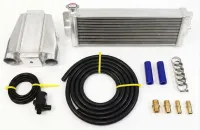
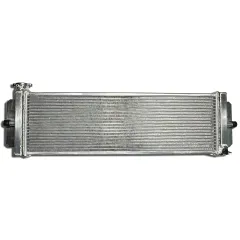

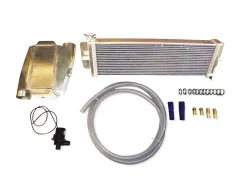
Water-Cooled Intercooler Systems: Technical Analysis and System Comparison
Thermal optimization of the intake air is a key factor in increasing engine efficiency, maintaining the knock limit, and ensuring durability in turbocharged internal combustion engines.
When designing the system, developers face a fundamental decision between air-cooled (air-to-air) and liquid-cooled (air-to-water) intercooler concepts.
Technical Comparison: Air-to-Air vs. Air-to-Water
1. Conventional air-to-air intercoolers (LLK)
Thermodynamic principle: The thermal energy of the compressed charge air is transferred directly to the ambient air via a heat exchanger located at the front of the vehicle.
System Characteristics & Limitations:
Volume and Response: Large intake and exhaust volumes, as well as long piping runs (from the turbocharger through the front and back to the throttle valve), result in increased dead volume. This results in increased transient pressure loss and delayed boost pressure build-up (turbo lag).
Thermal Behavior (Heat Soak): At low vehicle speeds, in stop-and-go traffic, or under high load on the racetrack, the mass flow of ambient air drops drastically. The system tends toward thermal saturation, resulting in a significant increase in intake air temperatures.
2. Water-Cooled Intercooler Systems (Air-to-Water)
Thermodynamic principle: Cooling is provided by a compact heat exchanger integrated directly into the intake tract. A closed secondary circuit with cooling water transfers the thermal energy to a separate front water cooler.
Technical advantages:
Minimal flow paths: The compact design, located close to the engine (immediately in front of the throttle valve), drastically shortens the charge air paths. Transient response improves measurably.
High heat capacity: Water has a significantly higher specific heat capacity than air. This enables more consistent energy absorption and more efficiently buffers load peaks.
Consistent efficiency: Since the external front water cooler can be positioned independently of the rest of the intake pipes, continuous heat dissipation is ensured regardless of the complexity of the intercooler piping.