

Fuel pressure regulator
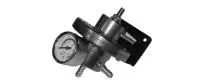
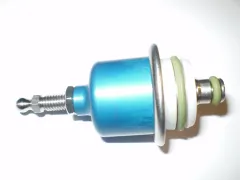
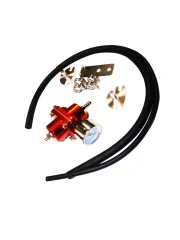
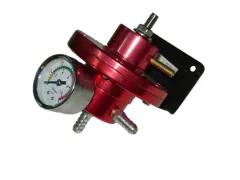
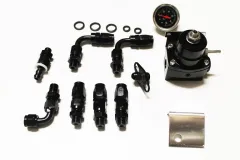
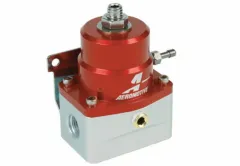
Adjustable fuel pressure regulators for motorsports and turbo conversions
In the field of high-performance engine tuning, precise control of the fuel supply is a critical factor for the engine’s reliability and maximum power output. In addition to modifications to the exhaust system or the turbocharger, the fuel pressure regulator (also known as the system pressure regulator) plays a central role in the fuel system. It ensures the exact differential pressure between the fuel rail and the intake manifold pressure to guarantee consistent air-fuel mixture formation.
At Turbo-parts.de, you’ll find a wide selection of adjustable and boost-dependent fuel pressure regulators, as well as custom-fit adapters for VAG 1.8T, VR6, and many other engine types.
Why upgrading the system pressure regulator is technically necessary
Factory-installed fuel pressure regulators are preset to a fixed, non-adjustable linear pressure (usually 3.0 or 4.0 bar). When performance is increased – especially during a turbo conversion – the demands on the fuel system change drastically:
Intake manifold pressure compensation: A mechanical, boost-dependent fuel pressure regulator increases fuel pressure in a 1:1 ratio to rising boost pressure. This prevents the boost pressure in the intake tract from “pushing the fuel back” into the fuel injectors.
Mixture correction at the limit: By manually adjusting the base pressure, the injection volume can be precisely adapted to a changed air-fuel ratio. This effectively prevents dangerous engine lean conditions (high exhaust temperatures) under full load.
The perfect spray pattern: Optimal efficiency at approx. 3 bar
A critical aspect of tuning the fuel injection system is fuel atomization. Modern fuel injectors are thermodynamically designed to generate the perfect spray pattern at a differential pressure of approximately 3 bar.
Insufficient pressure: Leads to poor fuel atomization. This results in excessively large droplets, which make the mixture inhomogeneous, reduce the combustion rate, and lead to a loss of power.
Excessive pressure: A significant exceedance of the optimal pressure window (e.g., well over 5 bar at base pressure) can deform the spray cone, negatively affect the response of the injector needle (inertia during opening/closing), and cause the spray pattern to collapse.
An adjustable fuel pressure regulator allows you to precisely adjust the static pressure to the injectors’ optimal operating range, even with larger fuel pumps or modified flow rates. The result is significantly more responsive engine performance and the elimination of power dips during transient transitions.
Technical Features and Adjustment Ranges (0–10 bar)
Our high-performance regulators are designed for universal use or as direct plug-and-play solutions for original fuel rails:
Precise adjustment via pressure gauges: Optional, high-precision pressure gauges allow for direct and error-free reading of the system pressure during the adjustment process.
Extended control range: The mechanical components allow for stepless adjustment of the fuel pressure from 0 to 10 bar.
Motorsport design: Equipped with high-quality, fuel-resistant diaphragms that remain dimensionally stable and diffusion-tight even when used with high-octane racing gasoline or E85. In addition, the housings are available in various anodized colors to meet aesthetic requirements in the engine compartment.
Integration into complete turbo kits
For comprehensive performance projects, we also offer fuel rails and pressure regulators as part of well-designed complete kits. In combination with upgrade turbochargers, turbo manifolds, intercoolers, and pop-off valves, our regulators form the hardware foundation for successful, knock-resistant map optimization on the dynamometer.
Technical support and expert advice at Turbo-parts.de
Proper design of the fuel system requires precise calculations of flow rates and pressure ratios. If you have questions about compatibility with naturally aspirated or turbocharged engines, or need help integrating the system into an original VR6 or 1.8T fuel rail, our technical support team is here to assist you.