


Racing catalytic converter
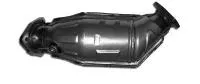
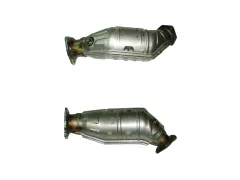

When tuning the 1.8T, many car owners focus on a better, more robust sound and Significantly noticeable power gains under the hood – but especially in times of emissions stickers and the like, exhaust emissions are playing an increasingly important role. As part of the exhaust system, the catalytic converter is a crucial and even mandatory component, used to convert harmful emissions into harmless ones.
\r\n
\r\n
- \r\n
- Carbon monoxide is converted to carbon dioxide
\r\n Especially in gasoline engines, carbon monoxide (CO) is produced when fuel combustion is incomplete—a gas that is hazardous to humans. It is converted into the less hazardous CO2 (carbon dioxide). \r\n
- \r\n
- Nitrogen oxides are converted to nitrogen
\r\n In most cases in the form of nitrogen monoxide (NO), nitrogen oxides are emitted into the atmosphere. Often produced at high combustion temperatures, this is a toxic gas that can be converted into nitrogen by the catalytic converter. \r\n
- \r\n
- Hydrocarbons (HC) are converted into water vapor
\r\n These gases are produced during incomplete combustion and are even carcinogenic in certain quantities. For this reason, a catalytic converter is extremely important here as well to convert the harmful HC into water vapor. \r\n
Why should you choose a racing catalytic converter?
To answer that, it helps to take a closer look at the catalytic converter. The construction of a racing or sport catalytic converter is always visually very similar. For example, the 1.8T racing catalytic converter consists of a honeycomb structure, a feature that is essential to its function. Whether made of ceramic or metal, the honeycomb structure creates a larger surface area through which exhaust gases can be channeled—resulting in an optimal reaction. The combustion gases are thus directed from the engine through the catalytic converter, where they are converted and expelled from the exhaust in a measurably cleaner state.
To achieve the best possible emission values for your vehicle, you’ll find various models in our online shop. For example, the Racing Cat / Sport Cat 200 CPI Euro 4, compatible with various Audi and Passat models with plug and play. As you can already see, this catalytic converter also has the advantage of fitting perfectly in multiple car types; “plug and play” describes the simplicity that the old catalytic converter can simply be replaced 1:1 with the new one. The registration in accordance with §21 StVZO must be carried out by an officially recognized expert and cannot be guaranteed. Since exhaust behavior depends on several factors such as exhaust temperature, engine power, displacement, etc., the specified Euro standard cannot be guaranteed either.
That leaves the question of the famous 100 or 200 CPIs, as also found in the sport catalytic converter shown above. Here, right from the start, it is necessary to clear up the misconception that a catalytic converter with 200 CPIs would in fact have only 200 cells. This is because the designation always refers to “cell per inch,” which corresponds to 2.54 cm. A 1.8T sport catalytic converter with 200 cells therefore has 200 cells per 2.54 cm—an area that will have a noticeably low-emission effect on your vehicle.
Whether you are planning to replace an entire Exhaust system or would like to replace the racing catalytic converter as an individual part, here you can get all the necessary parts in guaranteed top quality from the experts. If you have any questions about the catalytic converter or other components, feel free to contact turbo-parts.de and benefit from the opinion of the tuning experts.