


Connecting rod TFSI
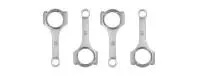
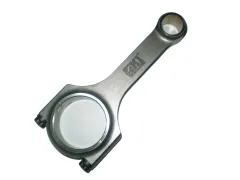
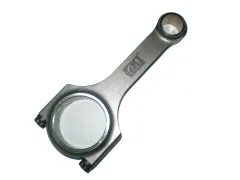
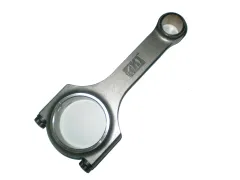
TFSI Tuning Connecting Rods – High-Strength Connecting Rods for Performance Gains
When mechanically tuning VAG TFSI engines (particularly the widely used EA113 and EA888 series), the connecting rods are among the components in the engine block subjected to the greatest stress. While the factory-installed cast or cracked connecting rods are optimized for stock performance, they quickly reach their mechanical load limits when torque is increased through ECU Tune or larger turbochargers. High-strength TFSI tuning connecting rods made of forged chromium-molybdenum steel (e.g., 4340 or 40CrNiMoA) provide the necessary buckling and tensile strength to effectively prevent engine damage caused by bent or broken connecting rods.
Comparison of Tuning Connecting Rod Designs
Depending on the intended application, target torque, and maximum engine speed, different connecting rod designs are used in TFSI tuning:
H-Beam Connecting Rod
Design: The cross-section of the profile resembles a large “H.”
Features: This design offers an excellent weight-to-strength ratio. H-beam connecting rods are extremely resistant to bending and optimally absorb high combustion pressures at low and medium RPMs.
Applications: The standard choice for high-end street tuning and moderate turbocharger upgrades.
I-beam connecting rod (I-beam)
Design: The cross-section resembles a double-T-beam or an “I” beam.
Features: This design is specifically engineered to withstand extreme tensile loads at very high RPMs. They offer even greater rigidity but are often slightly heavier than H-shaft connecting rods.
Applications: High-performance projects, extreme racing applications, and modifications featuring very large turbochargers that generate power across the entire RPM range.
X-Beam Connecting Rod (X-Beam)
Design: A hybrid design that combines the advantages of H- and I-shafts.
Features: Provides maximum stiffness in all load directions while optimizing weight distribution.
Application: Absolute high-end engines in drag racing or circuit racing with extreme boost pressures.
At what power level do the TFSI internal components need to be reinforced?
The need to reinforce the engine’s internal components depends primarily on the maximum torque ($Nm$) and depends less on the raw horsepower figure, since the bending load (cylinder pressure) is highest at the moment of maximum boost pressure build-up.
The following technical guidelines apply to the 2.0 TFSI engines:
| Performance Level / Torque | Relevance to Engine Internals | Technical Recommendation |
| Up to approx. 400 PS / 500 Nm | Stock internals are usually sufficient | OEM components can withstand thermal and mechanical loads when properly tuned via software. |
| From approx. 400–420 PS / > 520 Nm | Reached the limit of the production specification | OEM connecting rods tend to bend during abrupt torque build-up (e.g., due to overboost). Upgrading to forged connecting rods is strongly recommended. |
| From approx. 450 PS / > 550 Nm | Reinforcement is mandatory | In addition to high-strength performance connecting rods, OEM pistons should also be replaced with forged pistons at this power level to adjust the compression ratio and prevent ring groove fractures. In addition, reinforced connecting rod bearings (e.g., ACL) and ARP bolts are mandatory. |
Important technical note: Some older-generation engines (EA113, e.g., in the Golf 5 GTI / Edition 30 / Golf 6 R) feature slightly sturdier factory connecting rods than the early EA888 generations (e.g., Golf 6 GTI). Nevertheless, the limit of approximately 500 to 520 $Nm$ applies to both designs as a critical threshold for the valvetrain and cranktrain.
Technical Quality Features for Your TFSI Connecting Rod Upgrade
When replacing the connecting rods in your TFSI engine, you should pay attention to the following quality criteria:
Precisely balanced and weighted: High-quality connecting rod sets are delivered within tight weight tolerances (usually less than +/- 1 gram per set) to prevent crankshaft imbalance.
ARP2000 or Custom Age connecting rod bolts: The strength of the connecting rod is only as good as its bolting. The use of high-tensile ARP bolts is absolutely essential for operational safety at high RPMs.
Honed piston pin eye: A precision-drilled hole with an integrated oil passage or a bronze bushing ensures optimal lubrication of the piston pin under full load.